


Today’s story is brought to you by Fruit Riot. Frozen, tangy, candied grapes from the grocery store near my apartment were my craving between research-necessary plates of hearty meat and bread. Thanks to Fruit Riot for supporting People & Food.
“We’re the only Indian restaurant to ever have charcoal tandoors in our kitchen in Manhattan,” declares executive Chef Karan Mittal of Ambassador’s Clubhouse in a video published by Eater in May.
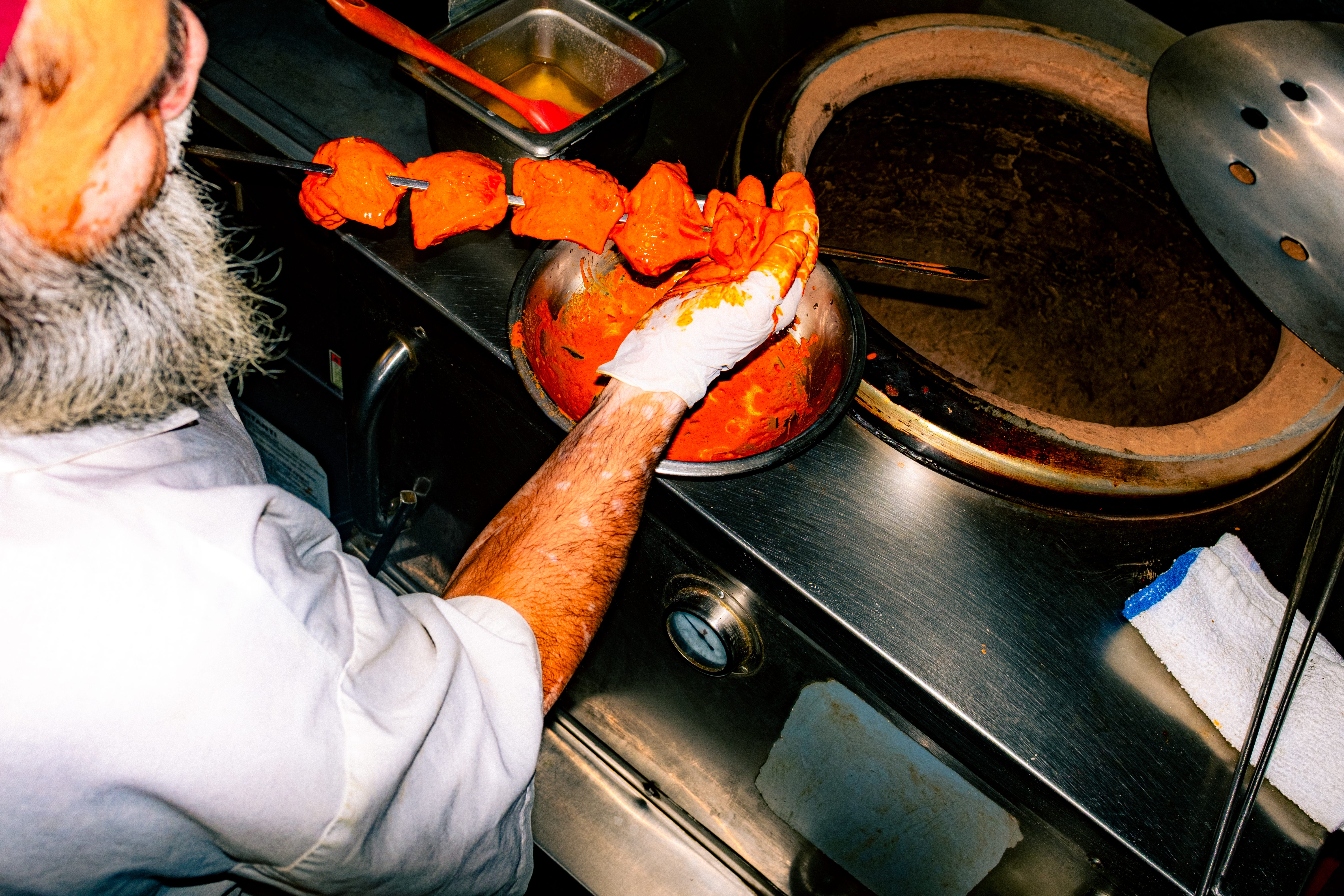
Cooks flutter around the kitchen’s tandoors: waist-high, cylindrical clay ovens in metal cases, meant for sticking in meat skewers, or slapping naan on the walls. At their bottom glows red-hot charcoal, which bake, grill, griddle, and smoke in an earthy concert. Mr. Mittal stresses that charcoal tandoor flavor is non-negotiable to the culture of Punjab, the northern Indian state. These days, most restaurant tandoors in New York run on clean-burning gas instead.
The glitzy Ambassador’s Clubhouse arrived in NYC earlier this year, a second to its original in London. There is allegedly a 12,000+ person waitlist; headlines brandish it “one of the hardest reservations in New York.” The restaurant is no underdog: a $100+ million hospitality group backs their claim of pioneering charcoal singularity in Manhattan.
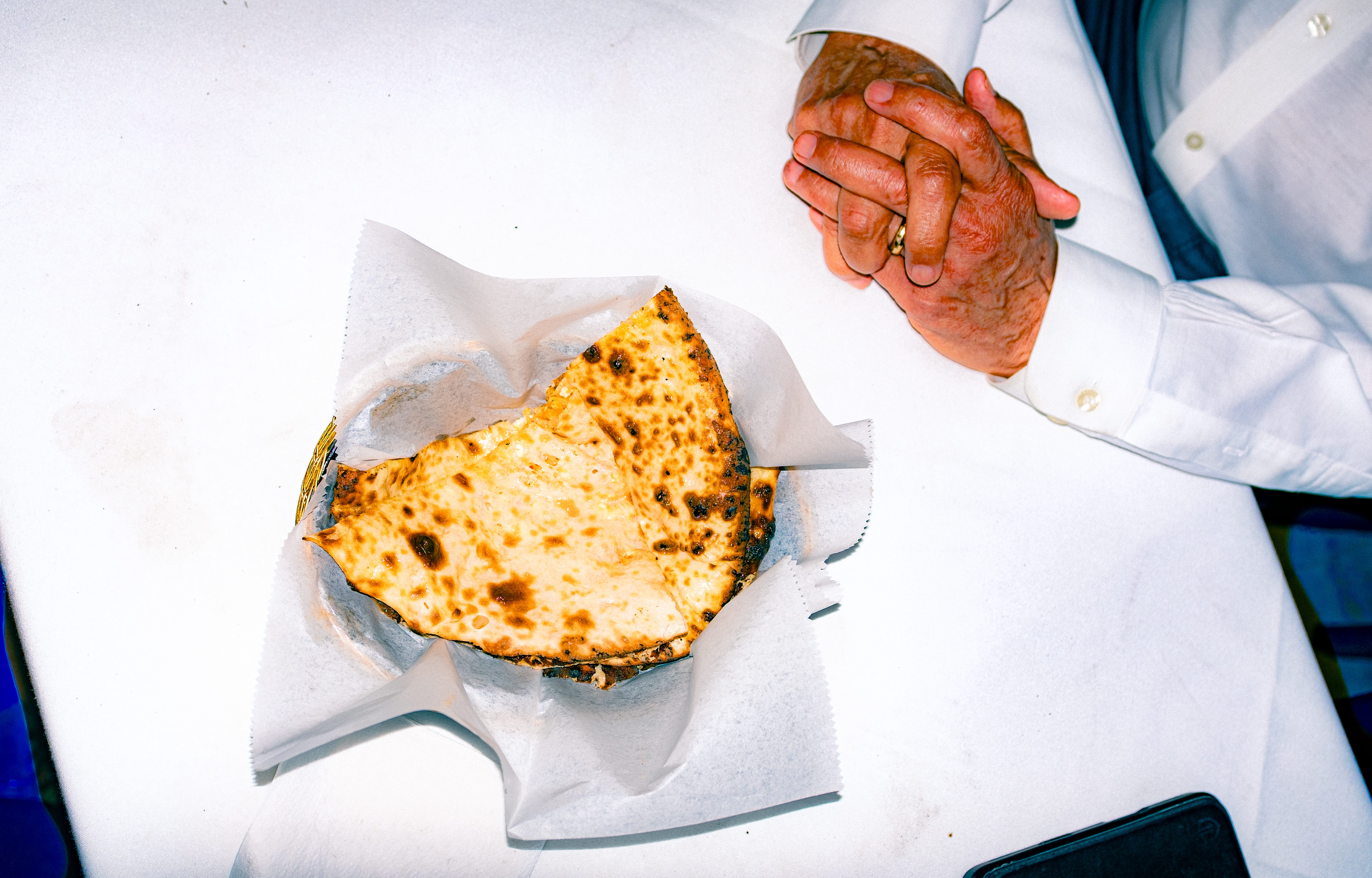
But I’m hearing a different story about charcoal tandoors sitting in Rego Park, at Tandoor Restaurant. Opened in 1989, it’s one of New York City’s oldest, still-operating Indian eateries. Across white tablecloth from me is the spry Vinnie Kumar, Tandoor Restaurant’s original and current owner (who laughed when I asked for his age).
“I came here in 1976 from New Delhi,” Mr. Kumar reminisces, looking out the window. “Back in those days, every restaurant in New York was charcoal.”
“Oh my God! I remember Gaylord restaurant on 58th Street…with a glass window for their tandoor. Line outside at 5 o’clock. LINE!” he emphasizes, flinging his arms towards the end of the block.
Gaylord’s 1974-opened Midtown East outpost was a franchise from New Delhi, steps from Central Park. And they weren’t the only Indian restaurant showing off their tandoor like a zoo animal to gawking New Yorkers of the 70’s, who were curious what this “igloo-shaped,” charcoal-heated oven could make.
A year later and a few blocks south came the spot Tandoor (not to be confused with Mr. Kumar’s later Queens joint), “put[ting] on a floor show behind a glass wall.” On the Upper West Side that same year came Indian Oven, whose owner fondly called their “glass enclosed kitchen…a total performance drama.”
These three mid-seventies-born spots with glassed spectacle seem to be amongst the earliest charcoal-powered tandoors in Manhattan restaurants. All have since closed.
The rise of tandoors in NYC was thanks to charcoal
Clay ovens in the northern Indian subcontinent can be traced back almost 5 millenia, burning wood, charcoal, even dung. However, tandoors in restaurant kitchens are pretty cosmopolitan.
What’s considered to be the first Indian restaurant in New York City opened in 1913. Ceylon India Inn was near Times Square, brought to life by a Sri Lankan immigrant. There didn’t seem to be a tandoor in his kitchen at the start; he served rice and curries closer to Sri Lankan and southern Indian fare.
Only after the late 1940s did “tandoori chicken” become a buzzword on Indian menus. Freshly independent India’s new northwestern border with Pakistan forcibly split the region of Punjab in half, and many Punjabis were pushed to the Indian capital city, New Delhi. Here spawned famed restaurants like Moti Mahal (1947) and Bukhara (1977), who popularized à la minute, char-kissed skewers and breads for urbanites drawn to rustic, “frontier-style” cooking.
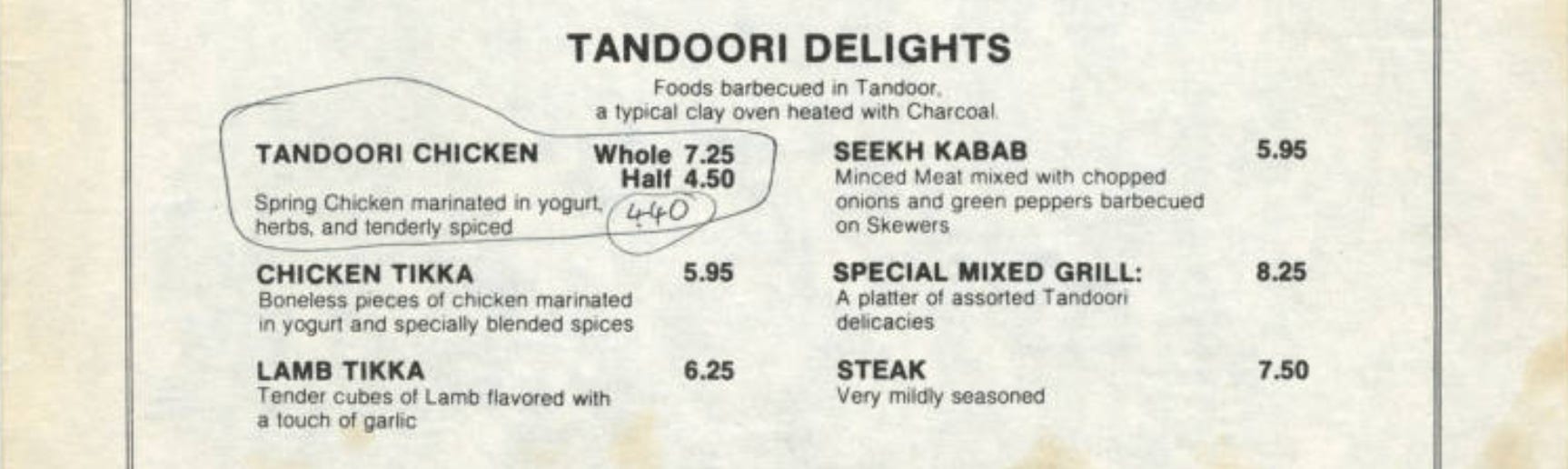
The tandoor craze then hit New York City. First came ‘tandoori’ spice blends that mimicked clay-charcoal oven flavor without the actual ovens. Then came drum-shaped clay vessels: critically, shipped empty and efficiently from India, easily filled with charcoal stateside. New Delhi cooks trained on charcoal tandoors immigrated to staff Manhattan kitchens. By the late 70s, charcoal tandoori chicken and naan were “typical” of and almost interchangeable with the word ‘Indian’ in New York, dotting numerous menus. Even Ceylon India Inn, by this time sold to and renamed by a Bengali family, added the earthen oven to their repertoire.
When imported tandoors cracked during transit and daily use, the restaurant Indian Oven called upon Manhattan-based ceramicist, Ron Levy, to craft unglazed, barrel-shaped vessels that could house charcoal. He succeeded. Word spread through the restaurant community of Mr. Levy’s quality; by 1989, he became “the leading manufacturer of tandoor ovens in America.”
What happened to NYC’s charcoal tandoors?
Most commercial tandoors sold now, including those from Mr. Levy’s legacy business, Homdoor, are inset with a propane burner. A sales representative of the company told me that he’s not in touch with any New York restaurants still using charcoal tandoors in their kitchens.
A different representative from Tandoor Morni -- one of the first manufacturers to achieve North American safety and sanitation certification (known in the industry as CSA & NSF) at the turn of the millennia -- tells me that they only make gas-powered commercial tandoors.
Mr. Kumar, the vibrant owner of Tandoor Restaurant, tells me that he switched his kitchen’s tandoors to gas in the mid-90s; indoor charcoal tandoors are nowadays “not possible” and virtually “illegal.” He cites the Smoke Free Act, passed in 1995 to limit indoor public smoking, for shifting how NYC thought about health and the environment. In the past decade, further Air Pollution Control Code has limited multiple kinds of solid-fuel cooking appliances in commercial kitchens, from wood-fired pizza ovens to charbroilers.
Multiple chef-owners I spoke with echoed this same feeling of having their hands tied. Chef Hemant Mathur, who has had a founding hand in almost a dozen tandoor-focused spots around town, explains that there are “strict fire safety regulations, ventilation requirements, exhaust systems, grease management, ash disposal, and multiple approvals from city agencies [the Fire Department, Department of Environmental Protection, Department of Buildings, to name a few]. All of those add cost…gas-fired tandoors became the practical choice.”
Chef Suhrob Mullojonov of the Uzbek restaurant Shashlik House tells me that the price of just the electrostatic precipitator filter -- which goes between the hood and roof exhaust fan, sucking up smoke and particulate matter -- can start at $70,000. Insurance companies will ask charcoal-using restaurants to cover not just their unit, but the entire building, because “charcoal is more hazardous than gas.” When Mr. Mullojonov opened his now-closed location on Cortelyou Road, permitting errors with his charcoal cooking system earned him a $20,000 ticket. Now, having painstakingly learned the systems, he operates one of New York City’s few restaurants with a charcoal tandoor and grill, which he must keep in a separate kitchen area than his gas tandoor. Still, Mr. Mullojonov chooses to cook his delicate samsa pastries in the restaurant’s gas tandoor, which he credits as having steadier flames.
On top of these costs, there’s the hurdle of rent that has to be eaten while work is undergone. Many restaurants don’t have this luxury. Ambassador’s Clubhouse was able to take 9 months to source their charcoal tandoor, attain UL listing (a customized health safety certification), as well as receive licensing for hoods backed up with fire suppression and tracking. A representative for Ambassador’s Clubhouse declined request for comment.
Fortunately, “fuel is only one part of the equation” to Mr. Mathur. An alum of Bukhara’s kitchen in New Delhi who moved to New York in 1994, Mr. Mathur had to make do with the gaseous landscape he was given. He went on to be dubbed “the Yo-Yo Ma of tandoors.” And like him, there are many more tandoor craftspeople who pay attention outside of charcoal: clay wall care, wall-sticking technique, creative ingredients, and on, and on.
It is as evident as ever that our city is full of folks fighting to keep tradition alive while time moves fast.
And the chronicles of these tandoors are part of an ancient story much larger than just South Asia. From Indus civilization, clay ovens to cook bread and meat played telephone with many other cultures: the Irani tanoor, Uzbek tandir, Georgian tone, and more. All genres of tandoor restaurants in New York have colorful histories of how they got their ovens in the first place, navigating charcoal restrictions, and leaving marks on staff forearms. But I’ll save some tales of shared humanity for the next installment of this tandoor rabbit hole.
For now, here are six South Asian tandoor-focused New York restaurants firing tastes honed by history and newly dealt cards.
