


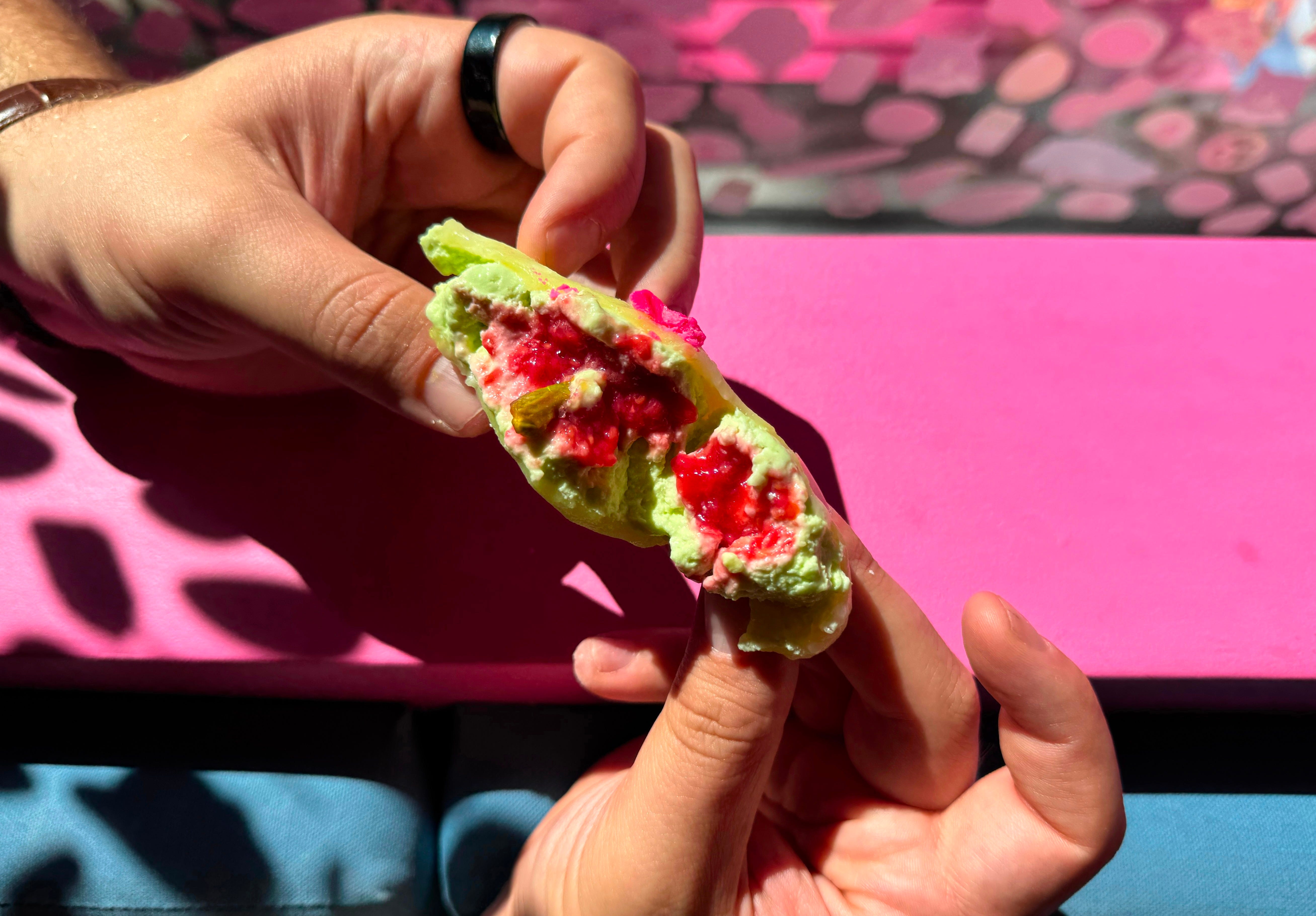
Four years ago, Pavlo Servetnyk was baking bread for Ukrainian soldiers. Now he’s handing me freshly-made mochi at his bubble gum pink cafe in the East Village.
The mochi here is anything but traditional. “For Japanese people, mochi is just dough,” Pavlo explains. “I try to combine two ideas: it’s French cuisine with the mousse inside, and outside is mochi dough.” But Pavlo’s culinary technique concerns me less than his background.
Behind the Instagrammable facade and eye-catching flavor combinations there is a question I haven’t yet gotten the answer to: How did a Ukrainian Master Chef who trained at Michelin-starred restaurants in Barcelona and Bangkok, who was targeted by the Russian army, end up making mochi here in New York City?
“It’s 2016 and I live in Ukraine, in a small city called Kherson,” Pavlo begins. As he speaks, he pulls down a small measuring bowl and places it on a scale. He meticulously measures out glutinous rice flour, granulated sugar, and water. The ingredients are whisked into a pale thin liquid that will unbelievably coagulate into mochi dough with heat and patience.
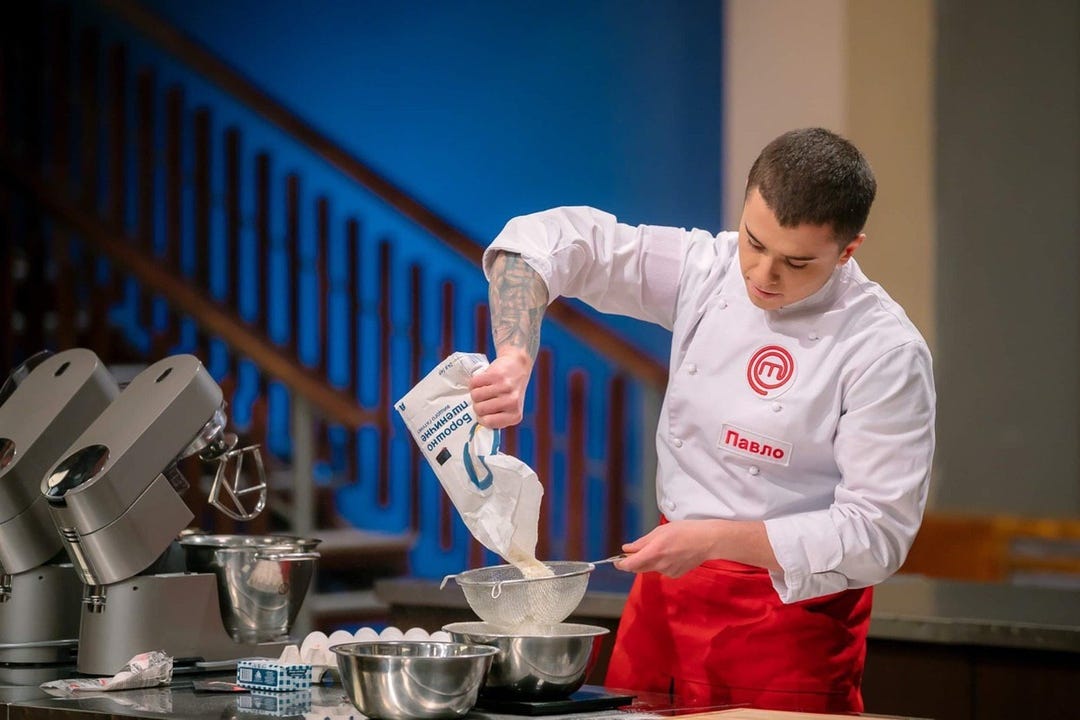
“I worked as a server at a restaurant and my first chef said to me, ‘A server never gets Michelin stars. You need to come work with me in the kitchen.’ I try just one day in the kitchen and I love it,” he says. “I won Master Chef after two years of kitchen skills, from regular cook to sous chef to chef position.”
In between brief rounds in the microwave, Pavlo gently folds the remaining liquid into the emerging dough with a spatula. As he scrapes the thickening dough off the walls of the bowl, he points out small flecks of white that indicate it needs more time. “Before the show I had never cooked pastries, but I understood if I want to win, I need to learn pastry. And now I make mochi.” He puts the mixture back into the microwave.
From his winnings on Master Chef, Pavlo was able to travel the world. First, he went to the three-Michelin-starred El Celler de Can Roca in Catalunya. Then he headed to Bangkok, to work at Gaggan, which was widely considered the best restaurant in Asia at the time.
How was your experience working at some of the best restaurants in the world?
My first internship at El Celler was an unbelievable dream. I had to learn one million rules, one million tools, one million techniques – everything new. And I still don’t care about nothing; if I need to wash the floor, I wash the floor. Many chefs start to respect me because they feel my passion and afterwards, Jean Roca wrote me a reference to Gaggan Anand.
That second internship was the worst internship experience in my life. Zero respect. Zero safety. And Gaggan’s mindset is like, “If you’re not an animal, it’s not your kitchen.” So I work six days per week, 16 hours each day. But I needed knowledge so I lived like that for three months. If something goes bad, I just try to switch something in my brain. Like okay, it happened, but I need to still be there and learn.
What’s the most important thing you learned there?
We had a special tradition once a week where two people made staff meal. In the restaurant, people came from many countries and everyone shared knowledge. One week, some guys from Japan taught us how to make mochi dough.
The microwave beeps again. The texture of the dough is completely different now, bouncing when poked and releasing a blast of steam with each sticky stir. Pavlo throws a pat of butter into the mixture and it melts immediately. Time is of the essence now; the dough has to cool enough to be mixed by hand, but not too much that the butter congeals.


“I go back to Ukraine and COVID starts,” he explains. Pavlo squeezes the dough and butter until they resemble cheese curds, then quickly draws his hands back, wincing at the heat. A mixer is out of the question – the dough would become too chewy. “I have some money left, and I opened a small bakery with my wife because I loved making bread... No one made the same bread quality like I made in that tiny city. It was an overnight success.
“After maybe six months, we opened three bakeries. We had a small production space. We delivered bread in three cities around my city, and 50 people work in my company. We start to be like a real company,” he says. “Then 24th of February, the war started.”
